The Third Grave
Set in Bodie, California, The Third Grave is a work of fiction that seeks to explore the lives of those who lived and worked in the boom town during its golden age.
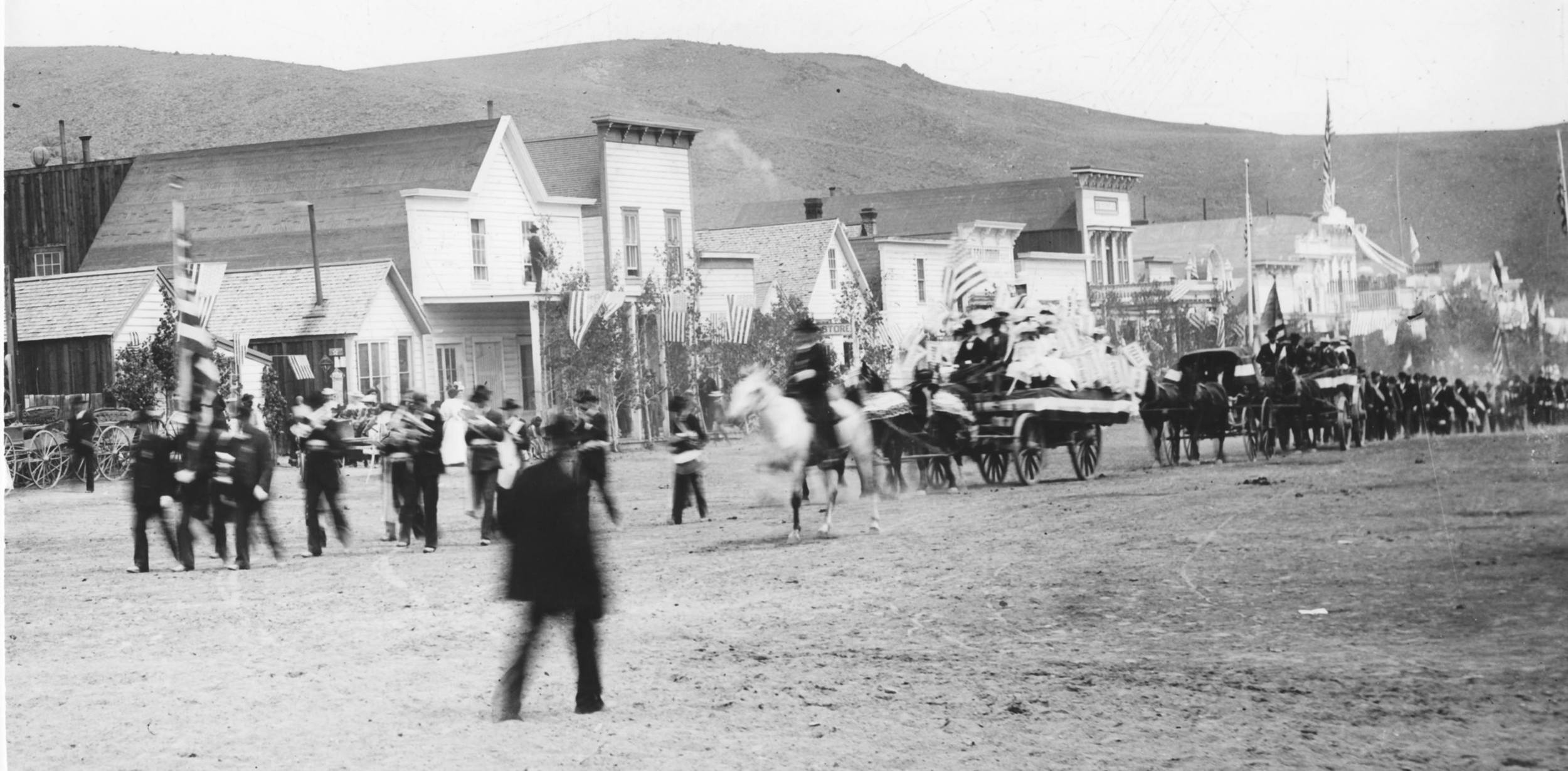
A 4th of July parade, Bodie, 1880s.
Excerpt from The Third Grave
Pelicans
When John leaves the heat and noise of the mine the sun is just beginning to light the low clouds a glowing red. From where he stands, just outside the superintendent’s house, he can see the whole of Bodie laid out before him. The whole town is touched with the pink light of the sky. Over the rounded Bodie hills he can see the razor edges of the Sierra. Smoke curls in the still, cool air, writing a script over the roofs of the houses. He starts to walk down the hill toward the cabin. He can’t yet bring himself to think of it as a home, not until Celia comes. For now it is a place where he takes his boots off and cooks pancakes on the stove every evening for his supper when the boys don’t ask him out.
Above him the sky intensifies, so bright it’s hard to believe it doesn’t make a sound. Such color, John thinks, should sound like a fire baring down on them. He lingers outside the cabin, looking up at it. A vee of birds soars into view over the hills. They are large and white and for a moment John thinks he’s seeing a host of angels. They are evenly spaced, their wings moving in the slow up-and-down of long-distance fliers. He doesn’t know what they are. Geese, maybe? Or Swans? He wishes Celia were here, he’d run in and pull her out by her hand, point to the sky, declare he’d brought a host of swans to decorate the sky for his pretty little wife.
But they aren’t white enough, he decides, to be swans. They seem dusky-headed, their wings marked darkly along the leading edge. He turns to watch them fly over, hoping they’ll land in the settling ponds and he’ll see what they are, but they don’t alter from their steady progress. Each appears exactly the same distance from the next. Where are they going, he thinks, flying east, away from the sun? He wants to call out to them, warn them that to the east all that there is is the great, flat white expanse of the Great Basin. A land so dry the only thing it grows is the white ribs of mules, horses, donkeys and men.
The thought of those inexplicable angels flying willingly into the heat-cracked land slips open the door of the place he hides his longing for his wife. He closes his eyes and turns blindly, reaching for the door. He wants to swing the door open and hear Celia call a greeting. Hear the uneven sound of Dizzy teetering across the wooden floor toward him. But when he opens his eyes he sees only the dusty floor, the sand drifting into corners. Each time he writes and waits for a reply he worries that Small Pox or a fever has taken them both while he was away. He knows that San Francisco is in the midst of another outbreak, as all cities seem to be when the heat rises. If they died, how long would it be before he was told?
He’d heard stories of men sending money home, sometimes getting a letter in reply only to travel and discover their family all dead and buried in mean plots, the landlord pocketing the money, his wife writing the replies. John doesn’t know that it’s true, but it sounds true enough for him. Outside he can hear the first of the evening wind beginning to murmur through the sage, he thinks it’s time he had his wife home.